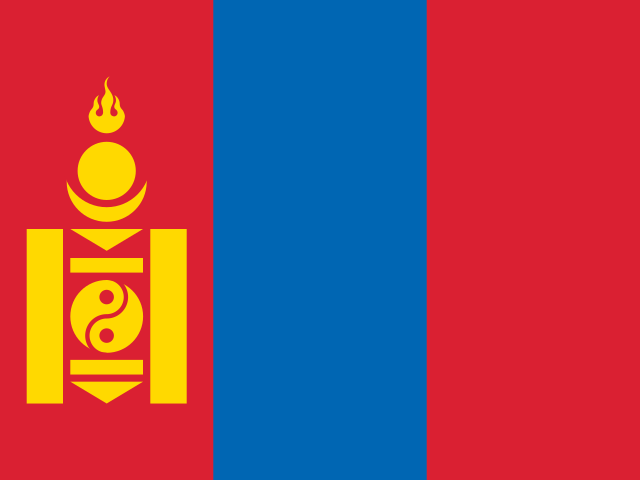
Flag of Mongolia

Mongolia: capital, population, area and flag

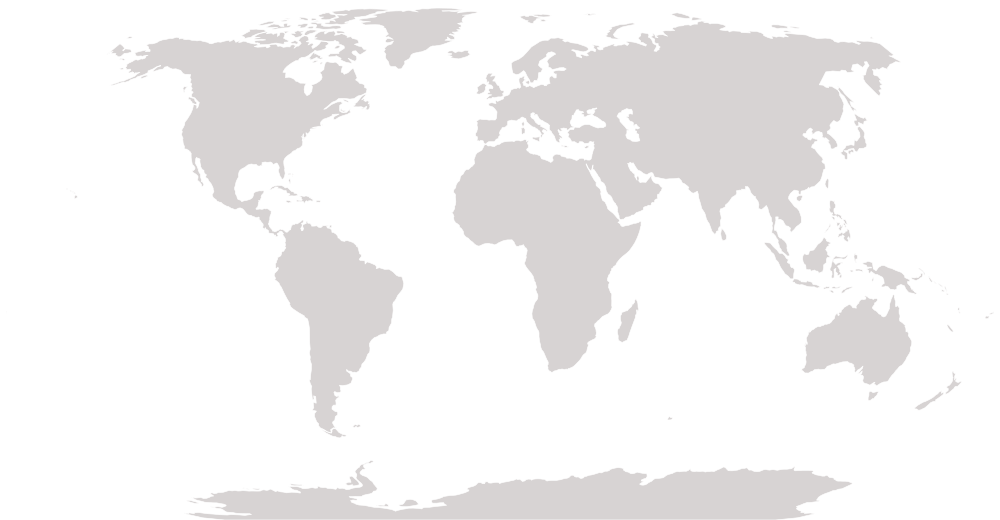
Mongolia is a country in Eastern Asia (Asia). Its capital is Ulaanbaatar. The population is about 3.57M (#130 of 193) and the area is about 1,564,116 km² (#18 of 193).

Key facts

Capital
Ulaanbaatar
Region
Asia / Eastern Asia
Population
3,568,978 (2025) #130 of 193
Total area
1,564,116 km² (2024) #18 of 193
Population density
2.3 people/km² (2024) #193 of 193
GDP (total)
$25.4B (2025) #121 of 189
GDP per capita
$7,108 (2025) #99 of 189
Life expectancy
72.4 years (2024) #112 of 193
Distance from Japan
3,008 km #188 of 192
Area compared with Japan
about 4.1 times that of Japan
Population compared with Japan
about 1/35 that of Japan
Main languages
Mongolian
Currency
Mongolian Tugrik (MNT)
Calling code
+976
Time zone (capital)
UTC+8
Time difference from Japan (standard time)
1 h behind Japan
Driving side
Right
Capital location
47.92°N 106.91°E

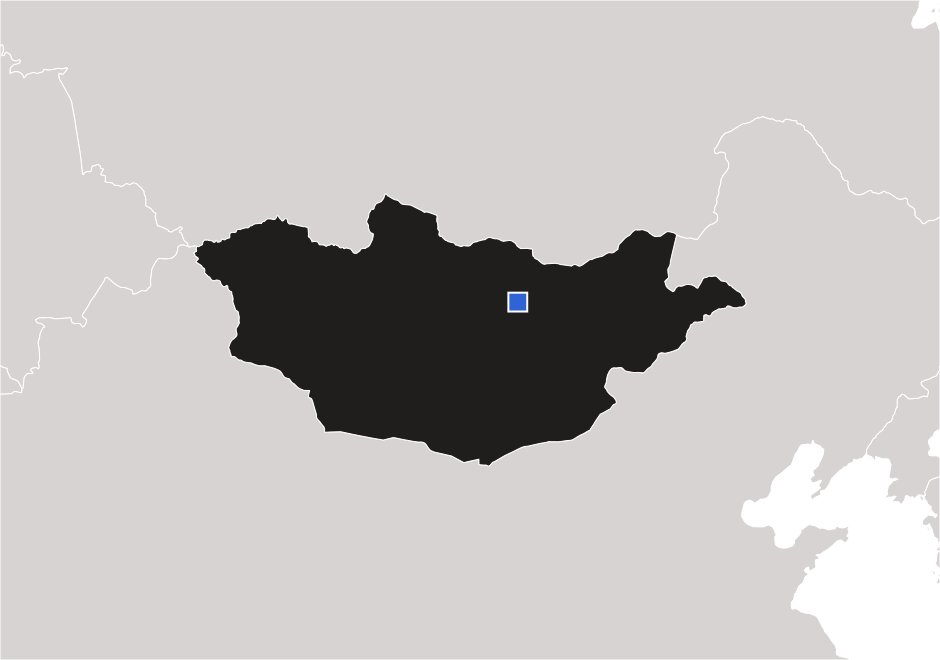
Map of Mongolia

Map of Mongolia

Capital: Ulaanbaatar

Mongolia: in the world’s top 10 for food & farming

Mongolia ranks among the world’s top 10 for these crops, animals, seafood and farm products (latest FAO data).

Neighbors by land
Top rankings

Mongolia is in the top 10 for:

Mongolia in world rankings

How Mongolia compares with other countries, indicator by indicator. Click an indicator to see the full ranking.

IndicatorValueYearRank
Geography & nature
Total area1,564,116 km²2024#18 of 193
Number of land borders2#109 of 193 tied
Latitude of the capital47.9°#24 of 193
Distance from Japan3,008 km#188 of 192
Forest area (share of land)9.1%2024#157 of 193
Arable land (share of land)0.7%2024#179 of 190
Protected land (share of land)19.8%2025#85 of 192
Agricultural land (share of land)68.8%2024#26 of 192
Average annual rainfall241 mm2022#160 of 180
Freshwater resources per person10,135 m³2022#44 of 181
Forest area141,783 km²2025#44 of 193
People & population
Population3,568,9782025#130 of 193
Population density2.3 people/km²2024#193 of 193
Population growth rate1.25%2025#79 of 193
Urban population (share of people)71.1%2025#69 of 193
Life expectancy72.4 years2024#112 of 193
Fertility rate2.50 births per woman2024#75 of 193
Infant mortality rate11.2 per 1,000 births2024#104 of 192
Birth rate16.9 per 1,000 people2024#87 of 193
Share of people aged 65 and over5.4%2025#119 of 193
Share of children aged 0–1431.6%2025#61 of 193
Life expectancy of women77.1 years2024#96 of 193
Life expectancy of men67.9 years2024#126 of 193
Maternal mortality ratio41 per 100,000 births2023#103 of 192
City dwellers living in the largest city (share)67.9%2025#8 of 149
Death rate (per 1,000 people)5.5 per 1,000 people2024#160 of 193
Under-5 mortality (per 1,000 births)13.4 per 1,000 births2024#102 of 192 tied
Population aged 15–64 (share of population)63.0%2025#119 of 193
Economy
GDP (total)$25.4B2025#121 of 189
GDP per capita$7,1082025#99 of 189
GDP per capita (PPP)$20,7982025#90 of 185
Economic growth rate6.8%2025#20 of 188
Inflation rate8.6%2025#28 of 179
Unemployment rate5.2%2025#86 of 178
Exports (share of GDP)68.1%2025#28 of 168
Imports (share of GDP)62.6%2025#44 of 168
Agriculture (share of GDP)8.9%2025#73 of 184
Industry (share of GDP)37.2%2025#21 of 185
Services (share of GDP)44.3%2025#156 of 185
Military spending (share of GDP)0.9%2025#123 of 155
Income inequality (Gini index)31.4 (0–100)2022#108 of 149
Goods exports (total)$15.8B2025#83 of 190
Money sent home by workers abroad (share of GDP)2.2%2025#88 of 170
Women in the labor force (share of women)51.5%2025#106 of 178
Youth unemployment rate11.7%2025#94 of 178
Cereal production443,153 t2024#121 of 177
Cereal yield (per hectare of farmland)1,251 kg/ha2024#146 of 175
Fish and seafood production (catch + farmed)31 t2024#188 of 193
Fish catch (from sea, rivers and lakes)31 t2024#186 of 193
Aquaculture (farmed fish and seafood)0 t2024#184 of 193 tied
Livestock production growth (2014–16 = 100)115.3 (2014–16 average = 100)2024#74 of 187
Fertilizer use (per hectare of arable land)46 kg/ha2024#118 of 187
Manufacturing (share of GDP)5.9%2025#141 of 178
Employment in agriculture (share of jobs)27.0%2025#68 of 178
High-technology exports (share of manufactured exports)22.5%2023#28 of 168
Foreign direct investment, inflows (share of GDP)10.8%2025#13 of 187
Development aid received (share of national income)1.4%2023#81 of 132
Labor force (number of people)1,457,9642025#134 of 178
Reserves of foreign currency and gold$7B2025#90 of 169
Extreme poverty (share living on less than $3.00 a day)0.4%2022#92 of 132 tied
Daily life & technology
Internet users (share of people)85.1%2024#79 of 186
Mobile phone subscriptions140.7 per 100 people2024#36 of 193
Access to electricity (share of people)99.1%2024#112 of 193
Health spending (share of GDP)6.1%2023#101 of 192
Education spending (share of GDP)5.2%2024#52 of 179
Hospital beds8.6 per 1,000 people2023#5 of 157
Doctors4.13 per 1,000 people2022#28 of 188
Research spending (share of GDP)0.08%2022#116 of 130
Women in parliament (share of seats)25.4%2025#98 of 192
University and college enrollment69.0%2024#51 of 163
Fixed broadband subscriptions15.8 per 100 people2024#86 of 192
Air passengers carried773,7022023#104 of 152
Safe drinking water (share of people)43.4%2024#103 of 136
Safe sanitation (share of people)69.9%2024#60 of 136
Undernourishment (share of people)2.5%2024#102 of 165 tied
Clean cooking fuels (share of people)59.0%2024#130 of 192
Road traffic deaths21.0 per 100,000 people2019#64 of 183
Measles vaccination (share of children)96.0%2024#46 of 192 tied
Secondary school enrollment (gross)96.8%2023#71 of 180
Primary school completion rate93.5%2024#97 of 172
Nurses and midwives (per 1,000 people)4.22 per 1,000 people2018#84 of 190
Tuberculosis cases (per 100,000 people)446 per 100,000 people2024#8 of 191
Health spending per person$3602023#105 of 192
Environment
Renewable electricity (share of power)10.9%2021#134 of 187
CO₂ emissions per person7.8 t CO₂e per person2024#24 of 186
CO₂ emissions (total)27.7 Mt CO₂e2024#76 of 186
Air pollution (PM2.5)42.7 µg/m³2023#19 of 192
Energy use per person2,396 kg oil eq. per person2024#46 of 146
Renewable energy (share of final energy use)3.0%2021#165 of 191
Electricity consumption per person2,969 kWh per person2024#67 of 146
Electricity from nuclear power (share of total)0.0%2021#33 of 190 tied
Electricity from hydropower (share of total)0.6%2024#138 of 190
Greenhouse gas emissions (total)104.4 Mt CO₂e2024#50 of 186
Freshwater withdrawal (share of internal resources)1.3%2022#143 of 175
Food & farming
Wheat: production397,258 t2024#64 of 120
Barley: production9,111 t2024#85 of 100
Oats: production35,601 t2024#42 of 74
Potatoes: production251,405 t2024#87 of 150
Rapeseed (canola): production59,354 t2024#40 of 63
Tomatoes: production2,070 t2024#140 of 164
Onions: production24,099 t2024#104 of 139
Cabbages: production53,019 t2024#69 of 143
Carrots (with turnips): production177,422 t2024#36 of 129
Cucumbers (with gherkins): production9,975 t2024#86 of 130
Mushrooms (with truffles): production353 t2024#55 of 63
Garlic: production2,047 t2024#71 of 102
Beef (cattle meat): production107,749 t2024#70 of 181
Pork (pig meat): production272 t2024#152 of 164
Chicken meat: production487 t2024#171 of 183
Cow’s milk: production191,760 t2024#115 of 178
Hen eggs: production11,794 t2024#112 of 167
Honey: production283 t2024#107 of 122
Sheep meat (mutton and lamb): production133,288 t2024#19 of 172
Goat meat: production63,789 t2024#16 of 164
Goat’s milk: production30,845 t2024#52 of 108
Butter (with ghee): production11,186 t2023#56 of 124
Cheese (all kinds): production1,963 t2023#98 of 105
Cattle: number of animals5,074,552 animals2024#53 of 183
Pigs: number of animals21,258 animals2024#138 of 165
Chickens: number of animals1,830,000 birds2024#151 of 181
Sheep: number of animals24,491,124 animals2024#14 of 173
Goats: number of animals22,920,180 animals2024#12 of 180
Horses: number of animals4,683,233 animals2024#4 of 143
Camels: number of animals480,567 animals2024#13 of 46
Donkeys: number of animals26 animals2024#103 of 104

Questions about Mongolia

What is the capital of Mongolia?

The capital of Mongolia is Ulaanbaatar.

What is the population of Mongolia?

Mongolia has a population of about 3.57M (2025), #130 of 193 among countries.

How big is Mongolia?

Mongolia covers about 1,564,116 km², #18 of 193 among countries.

Which continent is Mongolia in?

Mongolia is in Asia, in the region of Eastern Asia.

What currency and languages are used in Mongolia?

The currency is the Mongolian Tugrik. Main languages: Mongolian.

How does Mongolia compare with Japan in size and population?

The area of Mongolia is about 4.1 times that of Japan, and its population is about 1/35 that of Japan.

How far is Mongolia from Japan?

The capital, Ulaanbaatar, is about 3,008 km from Tokyo, the capital of Japan, in a straight line.

What is the time difference between Mongolia and Japan?

The capital, Ulaanbaatar, is on UTC+8 in standard time: 1 h behind Japan.

More countries in Eastern Asia
Play with Mongolia

Test what you learned in the quiz.

Map puzzle Quiz Rankings

Back to top